
In the world of professional broadcasting (Pro-AV) and rugged outdoor surveillance, power is everything. As devices like 4K/8K PTZ cameras, remote digital signage, and extreme-weather thermal cameras evolve, standard PoE+ (30W) no longer cuts it.
Enter IEEE 802.3bt (PoE++).
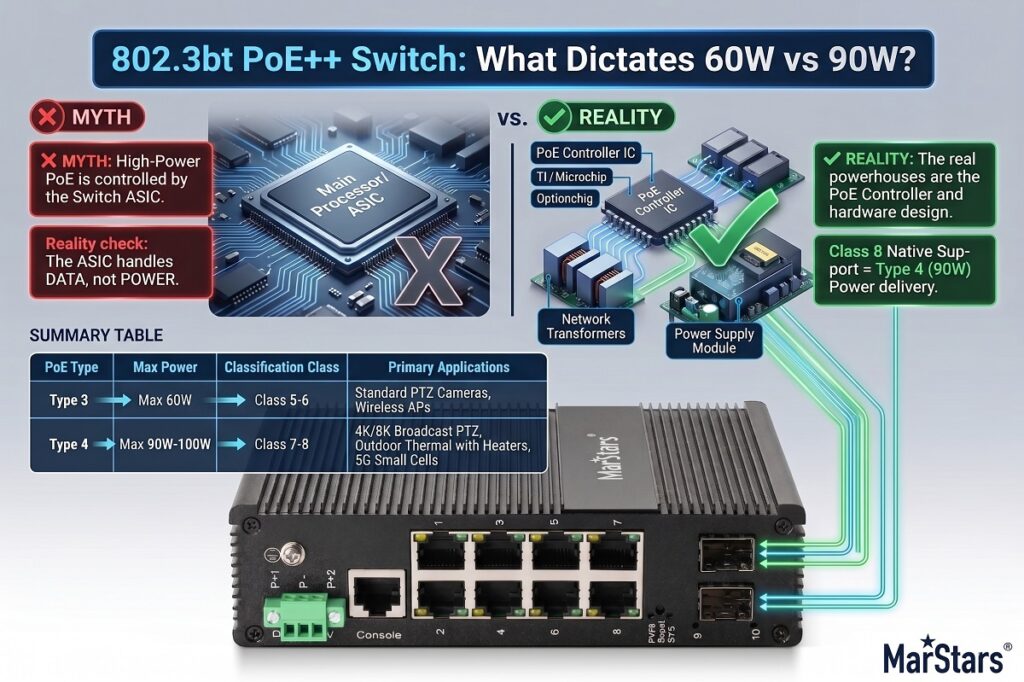
However, when system integrators and procurement managers source industrial switches or media converters, they often face a technical dilemma: What internal hardware components differentiate an 802.3bt Type 3 (60W) device from a Type 4 (90W-100W) device? Is it governed by the switch’s main processor or the PoE subsystem?
Let’s dismantle the hardware architecture to find the answer.
The Common Misconception: Blaming the Main Switch ASIC
Many buyers mistakenly assume that top-tier switch main chips (such as Marvell, Broadcom, or Realtek) dictate the power capabilities of the machine.
In reality, the Switch Main ASIC’s sole job is data packet forwarding (Layer 2/Layer 3 routing, VLAN tagging, QoS). It treats a 10W feed and a 90W feed exactly the same—as binary data.
In a managed industrial switch, the main chip only acts as a “messenger.” It uses an $I^2C$ or MDIO bus to read data from the PoE subsystem so it can display the power status on your Web GUI or SNMP dashboard. It does not dictate the physical electricity flowing through the RJ45 port.
The Real Decision Makers: PoE Controller IC & Power Architecture
Whether an industrial network device can safely blast 90 Watts of continuous power over a Cat6 cable depends entirely on two things:
1. The PoE Controller IC (The Brain of Power)
The PoE Controller (such as chipsets from Texas Instruments, Analog Devices/Maxim, or Microchip) is the silicon responsible for device detection, handshaking (classification), and power modulation.
- Type 3 (60W): Built on PoE controllers certified up to Class 6.
- Type 4 (90W-100W): Built on advanced PoE controllers certified up to Class 8.
The firmware and physical architecture inside the PoE chip dictate the absolute maximum power ceiling.
2. Network Transformers & Power Budget (The Brawn)
A Type 4 setup pushes up to $960\text{mA}$ of current through all 4 pairs of the ethernet cable. This massive current generates substantial Joule heat. To prevent the board from melting, the hardware must feature:
- Broadcast-Grade Transformers: Specifically wound to isolate high-frequency data from heavy DC currents.
- Massive Industrial Power Budgets: If a 4-port switch needs to deliver 90W per port concurrently, the internal power supply module must comfortably exceed $360\text{W}$ plus system overhead.
Sourcing Checklist for B2B Buyers
When evaluating vendors for your next broadcasting or smart city deployment, ask these two questions to filter out low-quality hardware:
- “What brand and model of PoE controller IC is used inside this 802.3bt switch?” (Ensure it natively supports Class 8).
- “What is the total power budget under extreme temperatures (-40°Cto 75°C)?”
Conclusion
Don’t judge an industrial switch purely by its data-forwarding processor. The true engineering marvel of high-power PoE++ lies in the thermal dissipation, the robustness of its network transformers, and native Type 4 PoE controller selection.
Are you designing a high-power network topology for Pro-AV or rugged surveillance? Contact [email protected] engineering team today to receive a fully compatible, high-reliability architecture proposal.